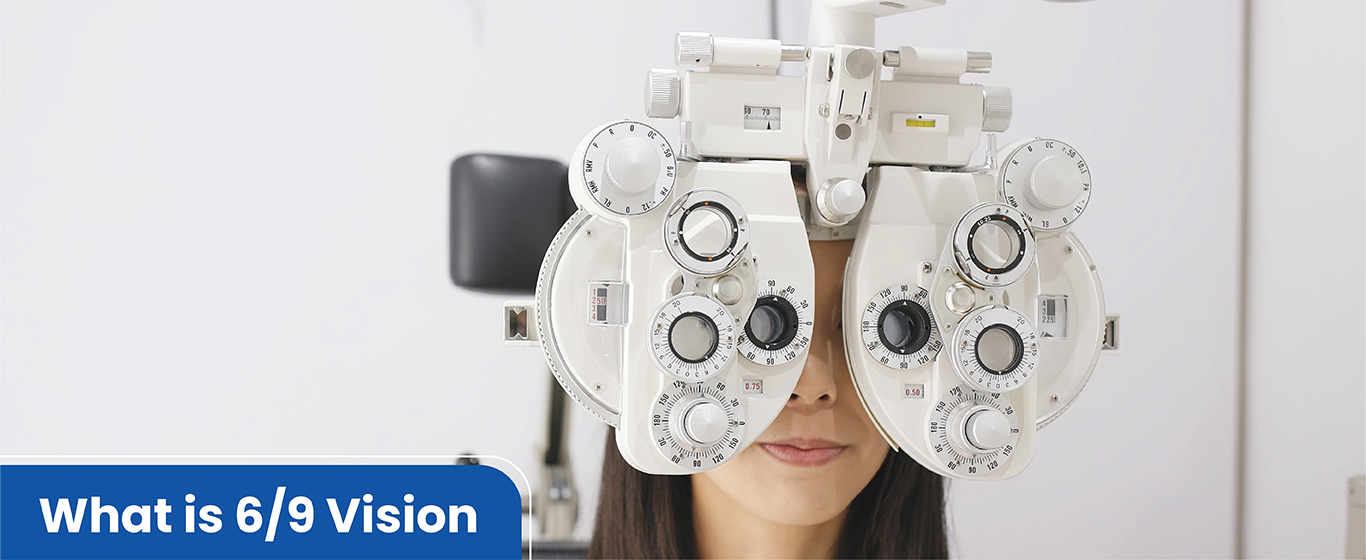
If your eye test report says “6/9” or “6/12”, you may be wondering whether it’s serious. The good news is that 6/9 and 6/12 vision is very common, usually mild, and in most cases easy to correct with the right glasses, lenses or treatment. These numbers only tell you how sharp your distance vision is, not why it is reduced, and that “why” matters most, especially for children whose eyes are still growing. In this plain-language guide, you’ll learn what 6/9 and 6/12 vision really mean, what causes them, and the simple ways to get back to clear vision.
What does “eye power” mean?
Your eye works a lot like a camera. The front of the eye bends incoming light so it lands exactly on the retina, the light-sensitive layer at the back. When the light lands in the right spot, you see sharply. When it lands slightly in front of or behind the retina, things look blurry.
“Eye power” is the strength of the lens (in glasses or contact lenses) needed to move that focus point back to the right place. It is measured in diopters (D):
Minus (−) power is for myopia (short-sightedness): distant objects look blurry, while near objects are clear.
Plus (+) power is for hypermetropia (long-sightedness): the eye has to work harder to focus, which can cause blur (especially up close), eye strain and headaches.
Cylindrical power is for astigmatism: the eye is shaped a bit like a rugby ball rather than a football, so things look stretched or blurred at any distance.
What does 6/6 vision mean?
6/6 is the standard for “normal” sharpness. It means you can read at 6 metres what an average person with healthy eyes can read at 6 metres. It doesn’t mean “perfect”: many healthy people see even better, at 6/5 or 6/4. Your sharpness depends on how well every part of the visual system works together, from the front of the eye to the brain. Genetics and how your eyes grew in childhood both play a part.
What does 6/9 vision mean?
The first number is the distance you stand from the eye chart (6 metres). The second number is the distance at which a person with normal vision could read the same line.
With 6/9 vision, you see at 6 metres what a person with normal vision can see from 9 metres away. Your eyesight is slightly below average, but you may barely notice it day to day.
Everyday example: at a football match, a person with normal vision can follow the players clearly from 9 metres away. You would need to be closer, at 6 metres, to see them just as clearly.
Possible causes of 6/9 vision:
- Mild myopia, hypermetropia or astigmatism (the most common cause)
- Early changes in the lens
- Dry eyes or a minor surface problem
- Less commonly, an early eye disease that needs a proper examination
When the cause is a small refractive error, the lens power needed is often small, in the region of 0.50 to 1.00 dioptre. This is only a rough guide, because acuity and prescription do not match exactly for every person. Only a proper eye test can tell you your actual power.
What does 6/12 vision mean?
6/12 is a step further. You see at 6 metres what a person with normal vision can see at 12 metres. You may squint at the board in class, struggle with road signs, or find it hard to recognise faces from a distance.
Does 6/9 or 6/12 always mean myopia?
Not always. These numbers only describe how sharp your vision is. They don’t explain why it is reduced. The cause could be:
- Myopia
- Astigmatism
- Hypermetropia
- Less commonly, an eye condition such as a lazy eye or a problem with the retina or lens
That is why a proper eye examination matters more than the numbers on their own.As a rough guide, when myopia is the cause, 6/9 vision often corresponds to about −0.50 to −1.00 D, and 6/12 to about −1.00 to −2.00 D. These are only ballpark figures and vary from person to person, so only an eye test can give your exact prescription.
Can 6/9 or 6/12 vision be “cured”?
It can be corrected, and it is simple:
Spectacles: the easiest and safest option. With the right lenses, most people reach 6/6.
Contact lenses: a good choice for people who prefer not to wear glasses, provided they follow hygiene rules and can opt for the contact lenses.
Myopia control for children: in growing children, myopia tends to worsen every year. Doctors can slow this with treatments such as specially designed lenses, low-dose atropine drops, or night-time orthokeratology lenses. They can’t reverse myopia, but starting early can keep it from becoming high myopia later in life. Spending time outdoors every day also helps.
6/9 and 6/12 Vision: 4 Things Most People Don’t Know
You’ve seen “6/9” or “6/12” on your eye report and nodded as if you understood. Most people do. Here is what the numbers really mean and the surprising facts that eye doctors rarely get time to explain.
1. “6/6” is not perfect vision.
The 6/6 standard comes from the Snellen chart, designed in the 1860s. It marks average-to-good sharpness, not the limit of human eyesight. Many healthy young people see 6/5 or even 6/4. So 6/9 vision is not “bad eyes”. It is simply a step below the standard, and it is worth knowing why.
2. The two numbers are a comparison, not a score
In 6/9 vision, 6 is the distance you stand from the chart. 9 is the distance at which a person with normal vision could read the same line. You see at 6 metres what others see at 9. With 6/12, they see it at 12. The bigger the second number, the blurrier your distance vision.
3. A small change in eye power makes a big change in vision
This surprises almost everyone. The jump from 6/6 to 6/12 can come from a tiny amount of myopia, around -0.50 D. At -1.00 D, vision at distance typically drops to around 6/15 to 6/24 without glasses, and at -2.00 D it can fall to around 6/45 to 6/60. (Exact results vary with pupil size, astigmatism and age.) Eye power may look like a small number, but vision falls off quickly as it grows.
4. 6/9 in a child is a window of opportunity
An adult with 6/9 vision is often stable. A child with 6/9 may be on the way to 6/12, then 6/18, because myopia usually progresses fastest between ages 6 and 14. Slowing options include:
Why early eye tests matter, especially for children?
Children rarely complain about poor vision. They assume everyone sees the way they do. Warning signs include squinting, sitting too close to the TV, tilting the head, rubbing the eyes, headaches, or falling grades.
Babies are usually born slightly long-sighted (around +2.00 D), which normally reduces as the eyes grow. Doctors sometimes use special drops to measure a child’s exact power accurately. If significant long-sightedness or a difference between the two eyes goes undetected, it can lead to amblyopia (lazy eye), where the brain stops using one eye properly. Catching it in early childhood makes treatment far more effective.
Conclusion
6/9 and 6/12 are common, correctable results, not causes for alarm. A regular eye check-up (yearly for children and every 1–2 years for adults) is the best way to keep your vision sharp and catch problems early.
You Can Also Read For More Posts:
Ayurvedic treatment for myopia – Is it effective
An adult’s guide to amblyopia lazy eye treatment in India
To Know More, Talk to our Consultant. Dial +91-8235808080