
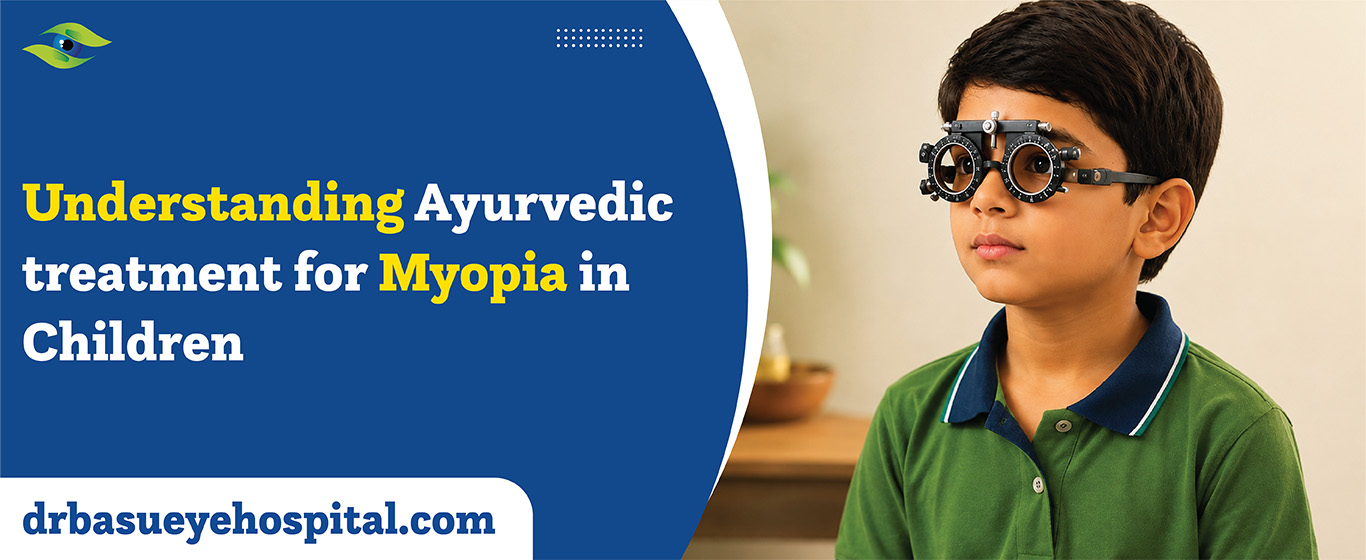
Starting primary school marks a big transition for every child — new routines, new friends, and a lot more reading, writing, and enhanced screen time often call for eye care, and the best way to get it is by Ayurvedic treatment for myopia. It’s an important phase when parents and teachers alike need to pay close attention to a child’s eyesight, since good vision is essential to roughly everything a young child does.
In addition to this modern, clinical approach, Ayurveda — India’s conventional system of medicine — has its own long-standing foundation for understanding eye health, one that looks at diet, daily routine, and the body’s internal balance as much as the eyes themselves.
What Is Myopia?
Myopia, or nearsightedness, happens when light entering the eye focuses just in front of the retina instead of directly on it, usually because the eyeball has grown slightly too long. The result is blurry distance vision.
Ayurveda for short-sightedness mostly first appears during the school days and doesn’t always progress to a severe degree. In many cases the number starts and the power progresses
-0.25 D → A very mild blur is often called the first stage.
-0.50 D → Slight difficulty seeing far clearly
-0.75 D to -1.00 D → The blur is noticeable; glasses are usually prescribed
In many cases the number becomes more negative as myopia progresses, i.e., from -2 to -3.5; this indicates that the distance vision has become blurrier. Other deductions include that the eye power has progressed (worsened). This mostly occurs due to
- Eye elongation (common in myopia)
- Excess screen time / near work
- Genetic factors
- Poor visual habits
There are many cases when the power becomes stagnant, like in this case, the power is still -3.5; it means that your myopia has stabilised and there is no rapid worsening currently.
Progressive myopia keeps worsening as the eye continues to lengthen over the years, sometimes reaching very high levels.
High myopia generally refers to prescriptions of around -6 dioptres or beyond, and in advanced cases a child may only be able to focus clearly on something held just a few centimetres from their face – making ordinary daily activities very difficult without corrective lenses.
The event of high myopia involves some pathologic changes in the eye, such as a higher risk of retinal detachment, though this doesn’t happen to everyone with high myopia. At Dr Basu eye care centre, our ayurvedic eye doctors offer myopia correction approaches designed specifically to protect children from reaching very high prescriptions and simple lifestyle habits – particularly spending some time outdoors and reducing screen time
How a Child’s Vision Develops
Babies are typically born a little farsighted. As the eye naturally lengthens and the lens matures, most children reach balanced, “normal” vision (emmetropia) by around age ten. Sharpness of vision also improves steadily in the early years, usually reaching adult-like clarity somewhere between six and ten years old. Around the same time, depth perception is maturing too, which is part of why coordination for things like riding a bike or catching a ball tends to click into place during the early school years.
Recognizing the Warning Signs
Because young children, mainly school-age children, roughly 5 to 12 years old, often don’t realise their vision is becoming a problem – or don’t know how to describe it – parents and teachers need to watch for behavioural clues:
- Frequent squinting
- Sitting unusually close to the TV or holding books very near the face
- Headaches, especially after reading or homework
- Rubbing the eyes often or complaining of tired eyes
- Struggling to see the whiteboard from a normal classroom distance
A child who shows early signs of myopia before around age seven can get natural treatment for myopia in Ayurveda so that the risk of developing high myopia later on could be avoided. Hence, earlier evaluation and intervention will lead to much better outcomes.
Everyday Prevention: The Basics
Regardless of which health tradition a family follows, two habits consistently come up in vision research:
- Get outside — aim for at least two hours of daylight exposure a day. Outdoor time appears to reduce the risk of developing myopia and slow its progression in children who already have it.
- Reduce sustained near work — frequent breaks from books, tablets, and phones give the eyes a chance to relax and refocus.
An Ayurvedic Perspective on Eye Health
The term ‘myopia’ may not be used in Ayurveda, but it has always focused on netra roga, or problems of the eyes, as part of its overall concern for sensory health. Some key assumptions underpin this tradition’s view of visual difficulties in children:
In Ayurveda, the eyes are thought to be tightly influenced by Pitta dosha, especially a subtype termed ‘Alochaka Pitta’, which is said to be responsible for visual perception. When Pitta is out of balance (typically due to too much heat, poor digestion or irregular routines), the eyes are thought to be more susceptible to strain and weakening over time. Vata disruption is said to manifest in eye strain, dryness, and flickering or unsteady focus, and so Vata dosha, linked to movement and the neurological system are also relevant. A regular and peaceful daily practice (dinacharya) is historically advocated to help keep both in harmony.
Diet and Nourishment for the Eyes
The Ayurvedic teachings stress the need for supporting the eyes through diet:
- Ghee (clarified butter) is one of the most eye-friendly foods in Ayurveda and is regularly utilised in diet and particular eye therapies.
- Carrots, leafy greens, pumpkin, and orange or yellow fruits are foods that contain beta-carotene and other plant nutrients and are generally advocated, in keeping with the mainstream nutrition emphasis on eye-supportive nutrients.
- One of the most often mentioned herbal treatments is Triphala, a traditional blend of three fruits which is frequently used as an eyewash or consumed internally and is historically thought to help eye tissue health.
- Excessive fried, processed or very spicy foods are generally discouraged, as they are related to worsening Pitta.
Netra Tarpana and Other Traditional Practices
Ayurveda describes certain specialised therapies for the eyes, such as Netra Tarpana (a treatment where warmed medicated ghee is pooled around the eyes) and Anjana (the application of herbal preparations to the eyelids). These are traditionally administered by trained Ayurvedic practitioners and are generally framed as supportive or rejuvenating practices rather than a stand-alone treatment for structural changes like elongation of the eyeball.
Lifestyle Guidance That Overlaps With Modern Advice
Interestingly, several Ayurvedic recommendations align closely with what contemporary eye specialists suggest:
- Time in nature and natural light is valued in Ayurveda as generally balancing for the doshas — echoing the modern finding that daylight exposure protects against myopia.
- Limiting excessive close-up activity, historically referring to prolonged reading by dim light, maps naturally onto today’s concerns about screens and near work.
- Regular sleep and eating schedules are considered foundational to Pitta balance and, by extension, eye health.
- Simple eye exercises, such as gently rotating the eyes in different directions or palming (covering closed eyes with warmed palms), are commonly suggested to relieve strain, though these are generally understood as comfort measures rather than a way to reverse or reshape refractive error.
Myopia treatment in Ayurveda
Traditional Ayurveda practised at Dr Basu Eye Care Centre has helped many patients get rid of their spectacles or has definitely helped their eye powers to get reduced, ensuring an Ayurvedic cure for myopia. For a family drawn to Ayurvedic principles, a reasonable path is to treat his eye problem with regular eye examinations and follow the guidance of a qualified eye care specialist for diagnosis and any prescribed correction or myopia-management treatment, while incorporating supportive Ayurvedic habits — outdoor time, a balanced Pitta-friendly diet, steady routines and traditional eye-care practices under the guidance of a qualified Ayurvedic practitioner — as part of the child’s overall wellness.
If your child or you are suffering from a nearsightedness or farsightedness problem, it’s a good idea to consult an Ayurvedic doctor online at our eye care centre. A qualified Ayurvedic eye specialist can understand your condition and suggest a treatment plan that suits your lifestyle. Don’t ignore your eye health—take the first step today because early attention to a child’s vision, consistent outdoor time, and mindful limits on near work give a growing child the best chance at healthy eyesight for the years ahead.


