The Indian Journal of Ophthalmology suggests that over 50% of Indian adults may have refractive errors. There are various studies done on this, but the two most familiar culprits are myopia (nearsightedness) and hypermetropia (farsightedness). Both refractive disorders affect the eyes and how clearly we see the world; they differ in how they develop, who they affect, and how they can be treated.
Modern medicine typically offers glasses, contact lenses, or surgery as the only solutions. But Ayurvedic treatment for myopia & hypermetropia in India has been there for 5,000 years – a science of life that offers a deeper, root-cause approach that not only manages these conditions but, in many cases, can reduce power and restore natural vision.
What Is Myopia? (Nearsightedness)
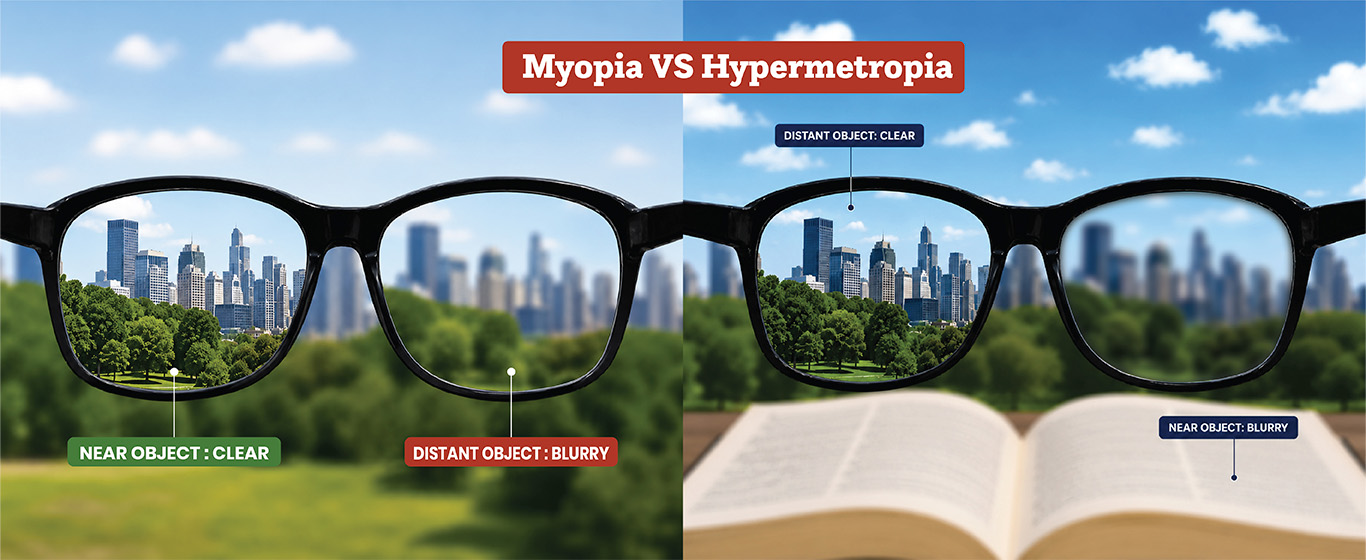
Myopia, also known as nearsightedness, is a refractive error in which a person can see nearby objects clearly but struggles to see distant objects. A child with myopia can read a book on their desk but cannot read the blackboard across the classroom. Myopia occurs when the eyeball is slightly too long, or the cornea has too much curvature, forcing light to focus in front of the retina rather than directly on it. This results in blurred distance vision.
Myopia in Children
Myopia in childhood (poor eyesight in kids) is growing at a very rapid rate, almost like a pandemic. The prevalence of myopia has increased dramatically worldwide in the recent decades. The global prevalence of myopia has increased from 24.3% in 1990 to 35.8% in 2023. That means
- In 1990, around 1 in 4 persons were myopic.
- In 2023 it was more than 1 in 3 persons.
- It might affect roughly 40% of the world by 2050.
In India it could be worse, with over half the population perhaps myopic by 2050.
Who can get myopia?
Myopia typically begins in childhood or early adulthood and tends to progress with age. Key risk factors include:
Extreme screen time and near-work (reading, studying on devices)
- Scarcity of outdoor activity and natural light exposure
- Hereditary factors — if both parents are myopic, the risk is extremely high
- Poor diet and nutritional deficiencies
- Prolonged use of digital screens from a very young age
Symptoms of Myopia
Blurred vision when looking at faraway objects
- Squinting or pushing to see far away
- Frequent headaches, especially after watching TV or a screen
- Difficulty driving, particularly at night
- Holding books or phones very close to the face
Ayurvedic Understanding of Myopia
According to Ayurveda, myopia is an imbalance of the Pitta and Vata doshas. Pitta rules vision, and when Pitta is disturbed, whether due to excess heat, screen exposure or mental stress, the photoreceptive ability of the eyes is weakened. But vata imbalance affects the nerves and muscles that support the focusing process of the eye.
Speaking about Ayurvedic treatment for myopia at Dr Basu Eye Care Centre, it is all about balancing these doshas with customised Ayurvedic medicines, specialist eye therapies, personalized food modifications and precise eye routines. Many people have reduced power in their specs and, in some cases, have completely eliminated spectacles.
There are various eye therapies available at our eye care centre, but the most preferred and prescribed eye therapy is Netra tarpan, in which medicated ghee is poured onto the eyes. It is one of the most powerful treatments for myopia. It deeply nourishes the optic tissues, relaxes the eye muscles, and improves blood flow to the retina.
Ayurvedic Exercises for Myopia
According to Ayurveda, ayurvedic exercises for myopia help to relax the eye muscles and balance Pitta and Vata doshas, which are often linked to vision issues such as myopia.
Palming (Netra Shanti): Rub your palms together, then gently place them over your closed eyes to relax and soothe eye strain.
Blinking Exercise: Blinking often helps keep your eyes moist and refreshed, which can reduce dryness caused by looking at screens.
Eye Rotation: Slowly rotate your eyes in circular motions to improve flexibility and blood circulation.
Focus Shifting (Near–Far Drishti): Look at something close, then at something far away, and repeat. This helps strengthen your eye muscles.
These practices, when done regularly, may reduce eye fatigue and support better vision naturally.
What Is Hypermetropia? (Farsightedness)
Farsightedness (hypermetropia) is the reverse of near-sightedness. A person suffering from hypermetropia can see the far items clearly but finds it difficult to perceive the nearby objects. Reading, writing or looking at a smartphone gets exhausting and foggy.
This occurs when the eyeball is too short or the cornea is too flat. Light is focused behind the retina instead of on it. This requires extra effort from the eyes, a process called accommodation, which causes strain, fatigue and headaches.
Who can get hypermetropia?
Both myopia and hypermetropia can exist from birth. Mild hypermetropia is normal in young children, as the eyeball is still growing. However, significant or uncorrected hypermetropia can lead to lazy eye (amblyopia) and crossed eyes (strabismus).
Risk factors are:
- Short eyeball structure, genetic or acquired
- Preterm birth/small for gestational age
- Aging – lens loses flexibility (presbyopia after 40 years of age)
- Long durations of detailed sustained near focusing without adequate pauses
- Nutritional deficits and flexibility of lens
Symptoms of Hypermetropia
- Blurred vision when reading or conducting close work
- Eye fatigue, strain, or burning while reading
- Recurring headaches focused around the eyes or forehead
- Problem with focusing on near items for long periods
- Eyes turn inward, especially in children
- Reading material must be held at arm’s length
Ayurvedic Understanding of Hypermetropia
In Ayurveda, hypermetropia is mostly witnessed as an imbalance of Pitta and Kapha. Kapha is responsible for keeping the eye’s structure and moisture in balance. When Kapha is out of balance, the lens can lose its shape and flexibility. When this happens, along with increased Pitta affecting the visual nerves, it becomes hard to focus on close-up objects.
Some Ayurvedic treatments for hypermetropia include Akshi Tarpana, a medicated ghee eye bath; Nasya, in which medicated oils are administered through the nose to support the optic nerves; and Netra Sekam, a herbal eye wash. These therapies aim to help the eyes focus better and prevent the condition from worsening.
Ayurvedic Highlights
It is important to treat hypermetropia in children early. If Ayurvedic care starts before age 8 to 10, the results are much better. The eyes may respond well to treatment and develop normally, so children may not need thick glasses as they grow.
Myopia vs Hypermetropia: At a Glance
Here is a comprehensive comparison of both conditions to help you quickly understand the key differences:
Difference Between Myopia and Hypermetropia
Feature | Myopia (Nearsightedness) | Hypermetropia (Farsightedness) |
Also Known As | Nearsightedness | Farsightedness |
Clear Vision | Near objects | Distant objects |
Blurry Vision | Distant objects | Near objects |
Eye Shape | Elongated eyeball | Shorter eyeball |
Dosha Imbalance | Pitta + Vata | Pitta + Kapha |
Common Age | Childhood / Teens | Birth / Middle Age |
Onset Type | Progressive | Often Congenital |
Headaches | When seeing far | When reading close |
Squinting | Yes, for distance | Yes, for near work |
Ayurvedic Therapy | Netra Tarpan, Netradhara | Akshi Tarpana, Nasya |
Surgery Option | LASIK available | LASIK / Lens Implant |
Ayurvedic Result | Power reduction possible | Vision stabilisation |
Powerful Ayurvedic Herbs for Both Conditions
Whether you have myopia or hypermetropia, several Ayurvedic herbs are known to support overall eye health, reduce inflammation, and strengthen the visual system:
- Triphala (Three Fruits)
Triphala is a blend of Amalaki, Bibhitaki and Haritaki and is considered the gold standard in Ayurvedic eye treatment. In the morning, washing the eyes with Triphala-infused water strengthens the muscles of the eyes, lowers redness and helps regulate the progression of myopia.
- Amalaki (Amla / Indian Gooseberry)
Amalaki is rich in vitamin C and antioxidants and is specifically advised for Pitta-related problems of the eye. The regular intake of the same nourishes the optic nerve and the retinal tissues – good for myopia and hypermetropia alike.
- Shatavari
Known for its nourishing, cooling and revitalising characteristics, shatavari is very effective in hypermetropia when the eyes need deep feeding and the lens needs improved flexibility support.
- Yashtimadhu (Liquorice Root)
Yashtimadhu has been used in classical Ayurvedic formulations for improving eyesight. It nourishes the nerves and has anti-inflammatory properties that benefit the visual pathway in both refractive errors.
- Punarnava
With its ability to reduce Kapha and detoxify, Punarnava is especially useful in hypermetropia. It reduces fluid retention in the eye and supports the proper structural integrity of the lens.
Ayurvedic Lifestyle Tips for Better Vision
Daily Habits to Protect Your Eyes
- Follow the 20-20-20 rule: every 20 minutes glance 20 feet away for 20 seconds.
- Spend at least 1-2 hours outside in natural light – especially beneficial for children
- Trataka (candle gazing) – a traditional yogic eye exercise to strengthen the eye muscles
- 7-8 hours of sleep – when sleeping eyes heal and rejuvenate
- Adopt a pitta-pacifying diet: avoid spicy, fried and processed foods
- Don’t read in low light or with the device screen at maximum brightness
- Every morning wash your eyes with cool water or triphala water
- Consume carrots, leafy greens, amla and nuts on a daily basis
Ayurvedic Treatment of Myopia and Hypermetropia
Ayurvedic treatment works best when started early. If you or your child shows any symptoms of myopia or hypermetropia, consult an Ayurvedic eye specialist immediately — do not wait for the power to increase significantly before seeking help.
Conclusion: Myopia and hypermetropia may be among the most frequent eye disorders in India, but they need not be a lifelong problem. Ayurveda provides a scientifically validated natural way to restore vision – beyond the lens and to the base of the problem.
Whether you are a parent worried about the increasing might of your child, a young adult fed up with the heavy glasses or someone in their 40s finding it difficult to read without eyeglasses, Ayurvedic eye care has something meaningful to give you.
At Dr Basu Eye Care Centre, every patient receives a personalised treatment protocol designed around their specific condition, dosha type, age, and lifestyle. With over four decades of legacy behind us, our mission remains the same as the day our centre was founded: to bring the healing power of Ayurveda to every eye that needs it.
Reference : https://pmc.ncbi.nlm.nih.gov/articles/PMC11994164/